

After a life-altering trauma, the author sought healing beyond conventional medicine. What followed was a demanding inner transformation—integrating fractured parts, rebuilding self-worth, and shedding inherited identities. Through somatic work, intuitive guidance, and spiritual practice, she championed a personal relationship with God, cultivated self-reverence, and learned to forgive, quiet the ego, and live from Love.
The place you grew up looks and feels different when you return to it after spending time away. I don’t think I need to spend too much time pointing out the myriad juxtapositions between New York City and a farming community in the middle of Virginia—although I will touch on two that stood out to me upon leaving the Big Apple behind.
The first is the wildness of nature. I realize that may be self-evident, but the shagginess of the foliage, the encroachment of grass onto roads, and the undergrowth flourishing in the woods, while completely normal, seemed foreign to me. I had become accustomed to nature on human terms—groomed and manicured to make it all nice, neat and just so. Here nature happened on nature’s terms.
The second juxtaposition: nighttime knew how to be night. It didn’t have an identity crisis in which it needed to have the lights on 24/7. As the warmth lingered into early Autumn, I would lie in the yard, gazing up at the stars. You could only see the brightest of stars in the city. Here, the limiting factor was the capacity of the human eyeball. I had forgotten just how many stars were actually up there…it was mesmerizing to look at.
My reaction to what I had endured was to withdraw, secluding myself within this den of natural wonder. Being around others was painful. Everything about it—from the intense shame to the hollow, disconnected sense of self—struck with visceral pain. Imagine being in the bottom of a well. The people you’re trying to talk to are above you—outside, standing at the edge. Any communication has to travel that distance. It echoes, sometimes distorts, sometimes gets lost. And always, there’s the quiet understanding: they can walk away, return to their lives. You, on the other hand, are stuck in the bottom of the well.
It didn’t help that I had a serious lack of trust in others and in myself. I no longer felt equipped to move through social spaces or to sense when something wasn’t safe. Nor did I trust others—to be sincere, to be safe, to be anything more than unpredictable variables in a confusing world. I was once told that I looked to be expecting catastrophe at any moment. I chose to view it as “waiting for the other shoe to drop.”
People whom I had once considered friends tried to contact me. They left me voicemails and emails. It hurt when I deleted them, unanswered. My alma mater even left a message on behalf of a schoolmate. According to the message, he had been trying to contact me without success and had reached out to the school to verify my contact info. I didn’t trust it. I didn’t trust the school. I didn’t trust him. I didn’t trust that the message was sincere. Hell, there were times when I didn’t even trust my childhood best friend.
I canceled any social media account I’d ever had, convinced information had been gleaned from them and used against me. (I was so distrustful of technology as a whole because of what had occurred that I rocked a flip phone until 2019. Actually, it wasn’t a distrust of technology itself, but rather how it could be used, coupled with the fact that I couldn’t prevent that usage, that concerned me.)
My isolation was further exacerbated by my belief that I could never tell anyone about what had happened to me—I was afraid I wouldn’t be believed. Moreover, I was terrified that, not only would I not be believed, but I would be deemed “crazy.” So, I kept it to myself, and it festered there. Everything and everyone had become a threat—even the thoughts that rattled around in my own head.
I kept myself occupied those first few months by immersing myself in physically demanding activity—and if it could be done outside, even better. One of the first things I did was plant a late garden. Keep in mind that farming is pretty much a spectator sport where I’m from. Had I wanted to plant this garden the “easy” way, I could have used some form of readily available machinery—a tractor with plow, a rototiller, etc. Instead, I dug and tilled the soil myself, using only a shovel and a hoe. It wasn’t a large plot—just twelve by twelve feet—but it was enough to spend some of my frenetic energy and indulge my self-loathing.
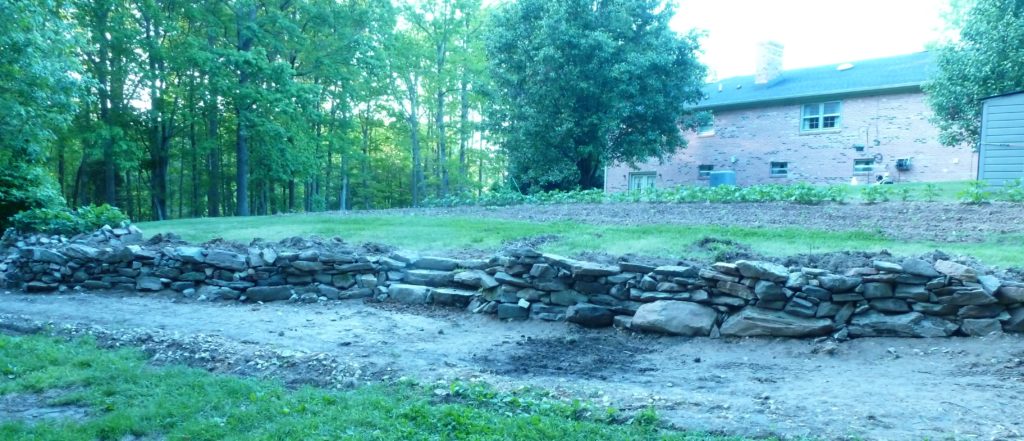
Next, I built a rock wall. (See picture below—I’m rather proud of it.) I gathered the rocks from around the property and began landscaping the backyard. Along with lugging and stacking rocks, I tilled more earth to prepare it for a shade garden filled with hostas, hellebores, ferns, etc. (This part isn’t visible in the picture because it’s located behind the photographer.) I also split, loaded, stacked, and hauled around firewood.

When I wasn’t wrestling with Mother Nature, I found other ways to fight myself: kettlebell drills to exhaustion, jump rope to exhaustion, hill sprints. I’d toss a medicine ball around a field just to chase it down, toss again, and repeat. I started every day with a Navy Seal ab routine, and I ended every day with treadmill sprints and plyometrics in the basement. I was in the best shape I’ve ever been in. (Which goes to show that you can be physically fit and, simultaneously, extremely unhealthy.)
Some days were worse than others. The bouts of physical exertion were interspersed with agonizing hours of lethargy and not wanting to get out of bed. I cried a lot. And cussing out God was practically a daily occurrence.
On the occasions when I did speak about what I was experiencing, I explained that I was tired and not in an I-need-a-nap kind of way. It felt like I just couldn’t get my brain to stop churning. I kept getting the image of an overworked hard drive that just couldn’t reboot. (If you’ve ever experienced a car engine that “runs high” upon ignition, just to be calmed by a firm tap on the accelerator, then you have an idea of what I’m talking about; only, no accelerator tap was working.) I discovered activities that alleviated this discomfort to a degree: Tetris and painting.
I found my old Nintendo Game Boy (the OG from 1989—it still worked!) and learned that playing Tetris allowed me to zone out while remaining present. I didn’t think about a thing—not even the score. I just focused on putting the shapes in their places, watching them disappear. It was calming. It was focusing. It quieted the noise.
Painting was another activity that could pull my attention from my past and focus it on my present. I was no Michelangelo, but I enjoyed doing it. I liked adding colors to where there were none and then watching their interplay.
There’s one more activity I want to mention—not for its immediate impact, but because it threads through a later part of the story. During this early phase, it occupied a significant portion of my mental bandwidth: I pored over theological material affirming the worthiness of homosexuality within the Christian faith. More precisely, I sought validation that a gay identity could coexist with spiritual integrity—that it wasn’t just tolerated, but inherently worthy. This fact will take on greater weight as the narrative unfolds, but it’s especially relevant here because it marked what I call active mental focus—the kind that requires deliberate engagement and cognitive effort, like the planning involved in gardening and landscaping. In contrast, Tetris and painting offered passive mental focus—a quieter, more meditative form of presence. The interplay between these two modes of healing—active and passive—will play out over and over again throughout my story.
This is also where I will say that the modalities required to treat mental-emotional health challenges, specifically trauma, are highly unique to each individual—it’s a highly unique wound. It’s a tailor-made wound that requires a tailor-made treatment. At the time, I had no idea what I was doing. I was just trying to feel better and naturally gravitated toward activities that resonated with me. I’ve always liked playing in the dirt. I’ve liked the feeling of partaking in and completing physically demanding tasks—always have. I’ve liked learning—always have…you get the idea.
It’s important to find what speaks to your soul and incorporate that into your “treatment plan” (and only you can know what these are—no doctor, who may or may not remember your name, can possibly know your interests and enthusiasms).
It never ceases to amaze me when a tiny, seemingly insignificant, seed is planted in the ground, and it becomes a strong, sturdy plant. I’m again amazed when that plant produces fruit that I can then take and use as food for myself—from seed to tomato soup—the wonder of it has never been lost on me. How does the seed know when it’s time to grow? How does it not get lost and suffocate under the density of the dirt? Who tells it when the “conditions are right”? What excites you might be quirky or absurd. Who cares? So long as it inspires a sense of wonder and provides a semblance of play, I think we’re on the right track.
Reflecting on this period of my life, I think I knew—on a deep level—that my mind-emotional body needed help, but I first needed to get strong and regain some sense of safety before I could address it directly. My mental body wasn’t up to the task of caring for myself, so my physical body stepped in. In becoming the fittest it had ever been, it provided scaffolding for my inner infrastructure. The body had to carry the mind because the mind couldn’t walk on its own, so to speak. This give-and-take between the physical and mental aspects of my being has been a constant throughout my journey. When I focused on building physical strength, my mental and emotional selves rose with it—each effort reinforcing the others. But when external stressors like work or life demands piled on, I struggled to maintain balance across all dimensions of my well-being. I couldn’t always reconcile the needs of my body, mind, and spirit simultaneously. That’s why I believe integrating both physical and mental focus into our standard treatment process is so, so important. (It’s interesting to note that engaging the physical body often brings up aspects of a person’s personal history—stored in the unconscious—that need to be addressed. More on that later.)
In the Mind-Body-Spirit understanding of the human being, meaning all three of those systems play a role in providing our human experience, it is vitally important to include a person’s spirit in the treatment of mental health. In my opinion, the spirit component has dominion over both the mind and body components. Think of the entire system as a tree: the spirit is the root system. The mind and body are the trunk and branches, visible and active. Without strong roots, the tree can’t stand, and without branches, it can’t reach. My spirit knew I had become ungrounded and guided me to activities that enforced safeness and stability. Through the quiet rituals of gardening and landscaping, I engaged with the elements of the earth—soil, water, stone, and sunlight. (It’s curious how healing can be triggered by something as Neanderthalish as sticking your hands in the dirt.) That experience also deepened my appreciation for nature’s cyclical rhythm—its constant movement and perpetual insistence on change. The best outcomes emerge when you move with its natural cadence.
It took eight months until I felt “safe” and strong enough to re-enter the workforce. Even then, I found it to be a terrifying prospect. That’s where we’ll pick up in the next posting.